Getting acne under control can feel like a major turning point. The painful breakouts settle, new spots become less frequent and you finally feel as though your skin is behaving again. Then you start noticing what has been left behind.
At Enhance Clinispa, we often see patients at exactly this stage. Their active acne may be much better, but they are left with uneven texture, small indentations across the cheeks, deeper pits where the acne was particularly severe, or lingering red and brown marks that can make the skin look as though it is still breaking out.
This is where acne and acne scarring need to be treated as two separate problems.
Clearing active acne helps prevent ongoing inflammation from causing further damage, but it does not automatically rebuild collagen that has already been lost or restore areas where the structure of the skin has changed. Once true acne scars have formed, improving them usually requires a different approach.
Why Do Acne Scars Remain After the Acne Has Gone?
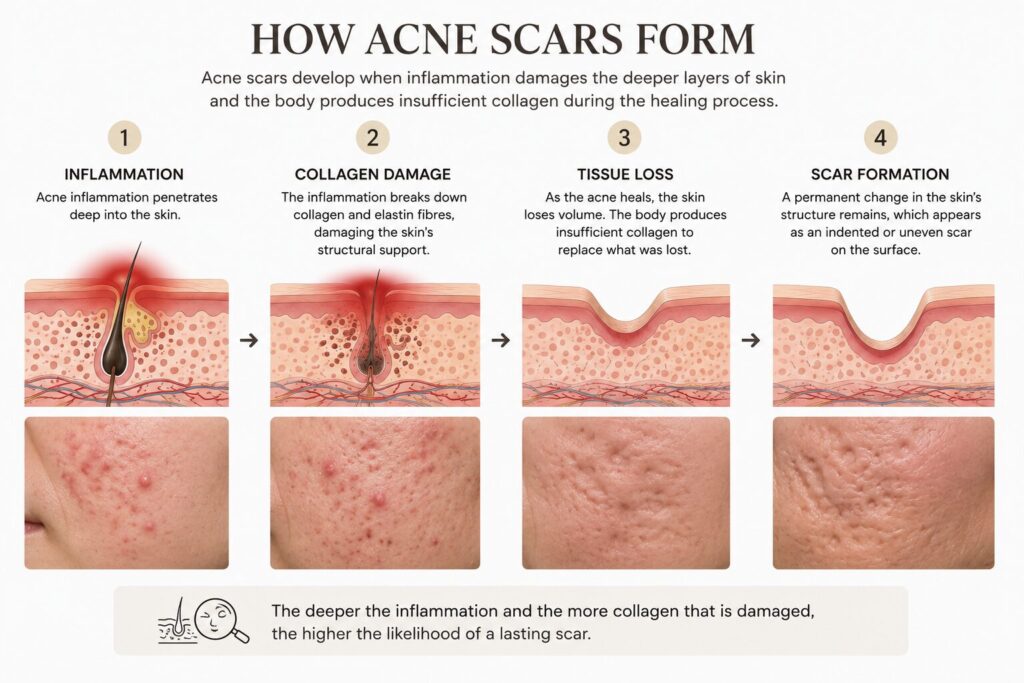
When an inflamed acne lesion develops, the inflammation does not necessarily remain confined to the surface. It can extend into the deeper layers of the skin where collagen provides structural support.
As the inflammation settles, the skin begins repairing itself. Sometimes that repair happens remarkably well and the spot disappears without leaving much evidence behind.
At other times, the healing process changes the amount or organisation of collagen within the area. If insufficient collagen is produced during repair, a depression can remain. This is how many of the indented scars associated with acne develop.
The likelihood of scarring tends to increase with deeper, more inflammatory acne, particularly nodules and cysts. Picking and squeezing spots can cause additional trauma and may increase the chance of a lasting mark or scar.
By the time the acne itself has cleared, therefore, you may be dealing with a structural change in the skin rather than an active skin condition.
Is It an Acne Scar or Just a Red or Brown Mark?
This distinction matters because they are not treated in exactly the same way.
After acne heals, it can leave behind a flat area of discolouration. Depending on your skin and the type of inflammation, this may appear red, pink, brown or darker than the surrounding skin. Although these marks can be persistent, they are not necessarily true scars.
A true acne scar changes the texture or structure of the skin.
Common patterns include:
- Ice pick scars, which are narrow and relatively deep
- Boxcar scars, which tend to look like wider depressions with more defined edges
- Rolling scars, which create broader dips and an uneven or undulating skin surface
Many patients have more than one scar type. They may also have pigmentation, enlarged pores or uneven texture alongside the scarring.
This is one reason why simply asking for “the best acne scar treatment” rarely produces a useful answer. The first step is identifying what is actually creating the uneven appearance.

Can Microneedling Get Rid of Acne Scars?
For appropriate acne scarring, medical microneedling can be a useful way of encouraging the skin to remodel itself.
At Enhance Clinispa, we use Derma FNS, a medical microneedling system that creates controlled microscopic channels within the skin. These tiny injuries stimulate a repair response, including new collagen and elastin production.
For acne scarring, that collagen response is the important part. Rather than covering a scar or simply exfoliating its surface, the aim is to gradually improve the quality and support of the skin beneath it.
Microneedling tends to make most sense when we are dealing with textural irregularity and suitable atrophic, or indented, acne scars. It can also be useful where enlarged pores and general skin texture are part of the concern.
Results develop progressively because collagen remodelling takes time. A course is commonly more useful than expecting one treatment to erase established scarring.
When Would INTRAcel Be Used for Acne Scarring?
Some scars require more intensive collagen stimulation.
INTRAcel combines medical fractional microneedling with radiofrequency energy. The needles enter the skin at controlled depths while radiofrequency energy generates heat within the tissue. This creates a controlled healing response designed to stimulate collagen and elastin production.
In practice, this gives us another level of treatment when improving the deeper structure of the skin is a priority.
At Enhance Clinispa, we often see patients whose concern is not one isolated scar but an overall change in skin quality following years of acne. There may be depressions across the cheeks, visible pores and an uneven surface that becomes particularly noticeable under overhead or side lighting. For these patients, treating collagen within the skin can be more important than concentrating solely on surface exfoliation.
Treatment intensity still needs to be appropriate for the individual. More aggressive does not automatically mean better, particularly when working with different skin types or skin that is prone to pigmentation.
When Is CO2 Laser Used for Acne Scars?
For more established textural acne scarring, laser resurfacing may become part of the conversation.
SmartXide CO2 laser resurfacing delivers controlled CO2 laser energy to remove damaged surface tissue while stimulating the skin’s natural regeneration and collagen response.
CO2 resurfacing can produce a more substantial remodelling response than lighter treatments, which is why it may be considered where scars are deeper or overall texture is significantly affected.
There is a trade-off. A stronger treatment generally means more recovery. SmartXide full-face resurfacing can involve redness, swelling and peeling while the skin heals, so suitability, expected benefit and downtime all need to be discussed properly beforehand.
For someone with relatively mild textural changes, jumping immediately to intensive CO2 resurfacing may be unnecessary. In more advanced cases, however, we would normally look at whether a stronger resurfacing approach offers enough additional benefit to justify the recovery involved.
CoolPeel provides another CO2 option at Enhance Clinispa. It uses SmartXide Tetra technology to deliver a more superficial resurfacing treatment with less thermal damage and shorter downtime. It can be useful when uneven texture and more superficial scarring are concerns, but the appropriate choice depends on the depth and pattern of the scars.
Can Chemical Peels Improve Acne Scarring?
Chemical peels have a different role.
Treatments such as EnerPeel and The Perfect Peel can support skin renewal and are particularly relevant when acne scarring exists alongside concerns such as pigmentation, oiliness or uneven surface texture.
EnerPeel includes different formulations that can be selected according to the skin concern. For example, EnerPeel SA is used for acne, while EnerPeel TCA is a stronger option used for concerns including scarring, pigmentation and skin texture.
The Perfect Peel is also offered for acne and acne-related scarring.
Where peels become particularly useful is in recognising that what a patient calls “acne scars” may actually be a mixture of problems. If much of the visible concern is flat post-acne pigmentation rather than deep depressions, a treatment strategy focused entirely on aggressive collagen remodelling may miss an important part of the problem.
Can Acne Scars Be Completely Removed?
This is an important expectation to get right.
Acne scar treatment is usually about improvement rather than complete removal. The degree of improvement varies according to the type, depth and number of scars, your skin type, how your skin heals and the treatments that are appropriate for you.
Deep ice pick scars do not behave in the same way as shallow rolling scars. Pigmentation does not respond like lost collagen. Skin that has been scarred for many years may also require a different approach from relatively mild, recent changes.
That is why assessment matters more than choosing a treatment based on a before-and-after photograph.
The goal should be smoother texture, less obvious depressions and a more even overall complexion, with realistic expectations about what your individual skin can achieve.
FAQs About Acne Scarring
Why do my acne scars look worse in certain lighting?
Indented scars create tiny changes in the way light falls across the skin. Side lighting and strong overhead lighting produce shadows within depressions, which can make texture appear much more pronounced than it does in soft, even light.
How long should I wait after my acne clears before treating scars?
There is no single waiting period suitable for everyone. The important point is that active inflammatory acne should be assessed and appropriately controlled before embarking on treatments that deliberately stimulate or resurface the skin. Your practitioner can determine when your skin is ready.
Can old acne scars still be treated?
Yes. A scar does not necessarily become untreatable because it has been present for years. However, the treatment required will depend on its type and depth rather than simply its age.
Why do my scars seem more noticeable as I get older?
Acne scars can sometimes become more apparent as skin changes with age. Gradual changes in collagen, elasticity and facial volume can alter the support surrounding an existing depression, making previously subtle texture easier to see.
Can I treat acne scars if I have darker skin?
Potentially, but treatment needs to be selected carefully. Some skin types have a greater tendency to develop post-inflammatory pigmentation after procedures that create heat or controlled inflammation. A proper assessment is therefore particularly important before laser, microneedling or peeling treatments.
Ready to Understand What Your Acne Has Left Behind?
If your acne has finally settled but the texture, indentations or marks remain, the next step is working out exactly what you are looking at.
At Enhance Clinispa in Bolton, Greater Manchester, your skin can be assessed to distinguish true acne scarring from pigmentation and other post-acne changes before deciding whether treatments such as microneedling, INTRAcel, chemical peels or CO2 laser resurfacing are appropriate.
Book a consultation to discuss your acne scarring and build a treatment plan around your skin, scar type and realistic goals.